Tuesday, October 29, 2013

Sweetening agents 2

There is nothing quite like commenting on sweetening agents to generate a response, often quite emotional. A couple of comments that are suitable for publication are reproduced in the letters section below. If I say something positive about a sweetener, especially aspartame, then someone will want to disagree. Let’s be honest, there are far more negative than positive comments about “artificial sweeteners” on the internet.
  
One enduring concern is that sweeteners cause cancer. This has been refuted by the Cancer Council and the famous Mayo Clinic and others, but maybe they are all working in collusion.

500 year old advice still relevant
Last month I attended the International Union of Nutrition Science conference in Spain. There I met Sir Andrew Renwick, Professor of Medicine at the University of Southampton, UK who has spent all his professional life in toxicology. He said that in “the last 46 years in studying sweeteners I have not seen any scientifically reproducible evidence that any sweeteners cause any harm to humans in the amounts normally consumed.”

He referred to the famous quote by Paracelsus (1493-1541) that “all things are poison … only the dose which makes something a poison”. There are variations on the translation, but simply put, it is the dose that determines whether something is good, neutral or bad for you.

Aspartame
He singled out aspartame, now approved in over 90 countries, stating that it has a larger safety database that any other food additive. Aspartame is a methylated dipeptide, comprising two amino acids phenylalanine and aspartic acid. You will remember from biology that amino acids make up proteins.

Some methanol is produced when aspartame is consumed, and you will hear people tell you scary stories about methanol, only because they don’t understand what Paracelsus said 500 years ago. Yes, methanol is produced but only in very small, non-harmful, amounts. There is more methanol in the same volumes of orange juice, apple juice and tomato juice than in a soft drink sweetened with aspartame. In fact there is six times more methanol in tomato juice than a diet drink, but you don’t hear scary stories about tomato juice, and neither should you because it is all about dose.

Nobody listens, no matter how many authoritative scientific reviews take place. Low-calorie sweeteners are among the most extensively studied of all food additives. Media stories about “health concerns” usually focus on a single recent observation and ignore the totality of the database available,” said Renwick.

Of course, because he says this, his words are quoted by agencies and companies that have a vested interest in sweeteners, so then people think that he has become a mouthpiece for sweeteners and can’t be trusted. That’s the way conspiracy theories work. One final comment he made was that the Wikipedia entry on the aspartame controversy was “surprising unbiased.”

Natvia
I was asked about Natvia, which is a mix of Stevia and erythritol. Stevia has been discussed in an earlier blog. It is quite safe.

Erythritol is not often found in foods, although it comes from a common family of sugar-alcohols, a bit like mannitol and sorbitol often used for its sweetness, mainly back in the 1980s in confectionery such as gum and mints. Some of you will remember Blizzard mints with sorbitol. I always remember them because, when lecturing at a university I mentioned Blizzard mints as an example of a product with sugar-alcohols. After a few minutes one quizzical student put up her hand and asked: “Where do you buy “lizard mince”?” A reminder to me to enunciate better. Yes, it was funny, and no, I don’t think lizard mince is legal either.

Anyway, erythritol is a sweetener with about two-thirds the sweetness of sugar. It has passed all the safety and toxicology tests thrown at it, even at high doses. It is absorbed from the gut and excreted through the kidneys unchanged. Its sweetness works well in combination with stevia.

What does it all mean?
If you eat sensibly, then there is a very good chance that you will eat somewhere between none and very little intense added sweetener, in which case it shouldn’t alarm you. If you are consuming two litres of diet soft drink, a litre of diet cordial, 1 kg of diet yogurt and 10 cups of tea with two tablets of sweetener per cup then I’m willing bet that your overall diet is pretty crap anyway. My blunt and unattractive view is that people focus way too much on minor issues of no consequence, distracting them from doing something useful like giving to charity, walking the dog and reducing the amount of the most dangerous food additive known to man. It’s called salt, but who cares?

And yes, I do enjoy a diet soft drink after a long bike ride (60+ km for me), so don’t think that I can be trusted to give you a balanced argument on sweeteners!

Tuesday, August 27, 2013

Obesity epidemic or obesity polemic


Earlier this year, a well-respected academic, Kathy Flegal, from the US National Center for Health Statistics, published a study that distilled all the research on overweight and mortality. It captured the research of 97 studies on almost 3 million people and 270,000 deaths so it gave a pretty good indication of the effect of excess body fat and your chance of early death.

So, being overweight will slice years off your life, right? No. And that wasn’t the answer most were expecting, nor was it the answer you want if you spend your life trying to scare people into losing weight.

If you are officially overweight, as measured by BMI 25-29.9, then you have a lower mortality rate than if you are lean, was the conclusion of the analysis. It’s only once you get into the official obesity level (BMI > 30) do you start to shorten your life. Not the impression you normally get, is it?

Forget respect, just get angry
The results did not please another very well-respected academic, Walter Willet from the Harvard School of Public Health. “This study is a pile of rubbish, and no-one should waste their time reading it” he said in an interview. He seemed to think it was giving the wrong impression and those carrying a few extra kilos may not see any reason to lose weight.
  
He felt that the public message would get confused, doctors wouldn’t encourage the mildly chubby to change their ways, and that the food industry at large could justifiably use the data to their advantage. In turn, the biostatisticians, turned the heat on Willet, stating that the conclusion was plausible. An editorial in the famous science journal Nature stated that public health authorities should stop trying to simplify messages if the message wasn’t simple. We’ve made that mistake before with the “Eat less fat” campaign 20 years ago.

Extra fat may not be a problem
This wasn’t the first study to show that being overweight doesn’t cause a health calamity. It is thought that carrying a little extra weight helps older people especially to survive intermittent medical problems and surgery that effects appetite. Put simply, if you have extra fat it becomes reserve energy for when you are sick and not eating. I have previously written that being overweight doesn’t mean that you are unhealthy. You might be one of the healthiest, fittest and best looking people in your town.

Is obesity a disease?
Personally, on a completely non-scientific level, I find it difficult to reason that if I now choose not to exercise, eat pizza daily, and spend 25 hours a week watching cook-offs and sing-offs on telly that I have now contracted a disease. It seems to me that I have just made a stupid decision, and stupid decision-making doesn’t usually respond to medical intervention.

On 17 June the American Medial Association (AMA) said that obesity is not a disease, partly because it is hard to diagnose. A public health problem maybe, but not a disease. If it is defined as a disease, then people might just assume that it is totally out of their control and they are going to wait for a medical solution.

Is obesity an epidemic?
Then it got political, and after strong lobbying, two days later the AMA decided that obesity was a disease. Not only that, it was an “epidemic”.

My Taber’s Cyclopedic Medical Dictionary defines an epidemic as an “infectious disease or condition that attacks many people at the same time in the same geographical area”. It isn’t infectious, and its onset has been gradual over 60 years. Does it fit the definition of an epidemic? Words like epidemic are used (much like the word “toxic”) to scare people, including politicians, so people take notice and provide research funds.

**Who to blame for the disease?
As you would expect, there was a big debate after the AMA came out with their final decision. Who can you blame for this disease? Will the disease be covered by medical insurance? If I get the disease, can I blame family members for giving it to me? Or anyone selling French Fries? Most diseases are cured by time, medication or surgery. Although surgery can help some with obesity, most are “incurable”.

My brain can’t classify obesity as a disease and neither can David Katz from the Yale Prevention Research Centre. On the other hand, being classified as a disease may just stimulate some government action. As long as it isn’t another silly public weight loss campaign.

Not my fault; it’s my doctor’s fault
In Australia, an obese bloke recently successfully sued his doctor because he didn’t “treat” his obesity with surgery. His claim was then overturned on appeal.

I’m sure there is more to this case than we know, but will this tactic become popular? Should we determine what/who caused someone’s excess body fat and then what/who is responsible for its disappearance? Once that is established, let’s engage a lawyer.

What does it all mean?
It seems to me that we continue to cast the public as a victim, and when you accept your position as a victim, then you can give up hope and begin to rely on outside agencies for a solution. Ignore the fact that these agencies don’t have a solution for obesity.

Only a fool will suggest that there is a solution. Sadly, there are many fools who proclaim they have a simple solution, from bans to taxes to plain bullying. It is widely accepted that any diminution in a population’s body size will require a combination of environmental change, food industry change, encouragement to be active from birth, health education and self-responsibility. It is that last part that no-one wants to mention, yet it may be the most effective.

But when was the last time you heard someone say: “Yes, it is my fault; I accept total responsibility” ?

Thursday, July 25, 2013

Sweetening agents

Sugar and honey

Sugar and honey have been a favourite way for humans to sweeten foods for years. Stinging bees were worth the threat to get to the honey reward. Cave paintings found in Spain depict honey collecting 8000 years ago. Certain ants in the Northern Territory of Australia store honey in their abdomen, to be used later as a food source for worker ants. Local indigenous people regarded these honey ants as a delicacy.

During World War II sugar became scarce. My father remembers using saccharin as a sweetener during the 1940s in England until sugar became more available. As sugar provides Calories/kilojoules, by the 1970s the world was looking for a low-joule version of sugar to help them keep control of their weight. Those with diabetes were also keen to avoid sugar-sweetened foods and drinks to help them control the sugar (glucose) levels in their blood.

During the 1970s the main low-joule sweeteners were saccharin and cyclamate. They weren’t the greatest tasting sweeteners, certainly not a patch on sugar, but it did mean people could drink calorie-free sweet drinks without affecting their blood sugar levels or weight. Those of a certain vintage will remember the drinks Tab and Tresca.

By the1990s new low-joule sweeteners were available and had a more pleasant taste than saccharin and cyclamate, both subsequently going out of fashion. Let’s take a quick look at some of the more recent sweeteners that have arrived in the food supply.


Aspartame
Probably the best-known intense sweetener is aspartame. It was discovered by accident in 1965 and approved for use in Australia in 1986. I remember the time well because I was working with teenagers who had diabetes and they hated the bitter aftertaste of diet drinks and were looking forward to drinks with aspartame that tasted more like they had sugar. Now aspartame is used in food and drinks in over 100 countries around the world.

Aspartame is merely a very small protein, comprising phenylalanine and aspartic acid, two amino acids found in much larger amounts in every protein-containing food that you eat, from bread to meat. This small protein just happens to be 200 times sweeter than table sugar. Strange, but true.

Yes, you will still hear negative stories about aspartame, especially via the internet and through your email inbox, but we have had nearly 50 years of studies showing that this low-joule sweetener is perfectly safe to consume in the amounts found in the diet. There is certainly no evidence that it causes brain tumours, the enduring concern that is often aired.

As it has phenylalanine, food and drink with aspartame will carry a message to parents with children who have the rare condition Phenylketonuria (PKU). About one baby in 10000 births in Australia will have PKU. With 300,000 babies born each year in Australia, that makes about 30 new cases of PKU. These children have controlled amounts of phenylalanine in their diet so they can lead a very normal life. Too much phenylalanine will cause brain damage in these children.


Acesulphame Potassium (K)
This sweetener was discovered soon after aspartame. It is also a low-joule sweetener about 200 times sweeter than sugar, which means that very little needs to be used to give the same sweet taste as sugar. Often it is used with aspartame to get precisely the right type of sweetness required for the food or drink, such as desserts, puddings, canned food, confectionery and soft drinks.

Like all low-joule sweeteners introduced to the Australian food supply it has been passed by our scientific and regulatory bodies, the National Health and Medical Research Council and Food Standards Australia New Zealand.

Around the world, before any sweetener can be used, it is assessed by the Joint FAO/WHO Expert Committee on Food Additives (JECFA), the Scientific Committee for Food of the European Union, and the Food and Drug Administration in the US.

Despite what you often hear, food companies cannot add any food additive they fancy, nor add them in amounts that suit them. They are all very tightly regulated and used in food and drink with at least a 100-fold safety margin, and that includes all the non-sugar sweeteners.


Sucralose
Sucrose has a similar structure to table sugar, although it is about 600 times sweeter than sugar. Like all sweeteners, it has undergone extensive testing since it was discovered in 1976 by researchers at Queen Elizabeth College in London. More than 100 studies have been conducted on sucralose since its discovery, with no safety concerns found. It is permitted for use in food and drinks in nearly 40 countries, including here in Australia, as well as New Zealand, Canada and the United States.


Stevia
This is the new kid on the block. We can’t really say it has been recently discovered because the natives of the area we now call Paraguay have been chewing on the Stevia plant for millennia. I have tasted the leaf from a home grown stevia plant and it definitely has a sweet taste, although not the same as sugar (so two leaves is my limit). The dried stevia leaves are soaked in water to unlock the sweet compounds in the leaf (known as steviol glycosides), which are then purified. This extract tastes more like sugar, yet has no kilojoules.

The safety of stevia sweeteners has been established based on their long history of use and more than 25 years of scientific research on the sweet-tasting components in the stevia leaf. All the major regulatory bodies around the world have approved it. Stevia is usually not used alone as its sweetness is most effective when in combination with some sugar, hence you will find drinks with only one third of its sweetness provided by stevia and the rest by sugar.


What does it all mean?
Non-sugar sweeteners have been used for a long time since saccharin was first isolated in 1878, over 130 years ago. We have been able to find a range of low joule sweeteners, whether by pure luck, or by searching the plants of the world for their natural sweetness. All the sweeteners have had their safety established before food companies can use them in a very tightly regulated fashion.

The benefits to using non-sugar sweeteners, especially in drinks, is that consumers can enjoy a refreshing drink with next-to-no kilojoules and no effect on blood sugar levels. That makes them ideal for people trying to control their weight or their blood sugar levels.

Sweeteners have no magic properties. Downing a diet drink won’t make you lose weight or make diabetes disappear. Having a ‘diet’ food in one hand and a donut in the other won’t have a cancelling effect. Low-joule drinks and diet foods always need to be part of sensible eating, not a substitute for it. Make wise use of them.

References:
Position of the Academy of Nutrition & Dietetics: Use of nutritive and non-nutritive sweeteners. J of the Academy of Nutrition & Dietetics 2012; 112: 739-758

Raben A, Richelsen B. Artificial sweeteners: a place in the field of functional foods? Focus on obesity and related metabolic disorders. Current Opinions Clinical Nutrition Metabolic Care 2012; 15: 597-604

Sunday, July 14, 2013

Calorie labelling on fast foods


In some parts of the world your favourite fast food will list the Calories or kilojoules next to each menu item. You assess your hunger, check your three yummiest choices, then wisely ask for the one with the lowest number next to it. I mean, you don’t want to be buying bigger clothes any time soon.

You can now classify yourself as weird. Ok, extremely unusual. Not many people do that.

A New York study of lunch time selections determined whether menu choice was influenced by having the energy level next to it. They checked 168 venues of the top 11 best-selling fast-food chains about a year before and a year after the introduction of Calorie labeling began in mid-2008.

On the face of it, no big difference
Overall, there was no change in the number of Cals/kJs chosen from the menu. Before Calorie labeling, people chose 828 Cals (3465 kJs) for lunch, after 846 Cals (3540 kJs). Statistically, that is no difference. Not good news.
  
Looking at the results further, there were some differences worth noting.

First, we need to know that this study was done in adults who could speak English. No kids or under 18s. Although customers were chosen at random, they knew they would have to hand their receipt to a data collector (in exchange for a free public transport pass as reward). True, that shouldn’t influence their choice, but it may have.

Over half of the venues were McDonalds and Subway, with pizza chains the next biggest proportion of the venues surveyed. And this was New York. Might be different in Wellington, NZ, southern Wales, Port Moresby, or that little place outside of Victor Harbour, South Australia.

About 1 in 7 made lower energy choices
When deciding on lunch, 15% said that they used the Calorie information. As you can guess, women were more likely than men to choose lower Calorie options, and this decision was also more common in wealthier neighbourhoods than in the poorer areas.

Those that used the Calorie information had a lunch with 100 Cals (420 kJs) fewer, on average, compared to those that ignored the information.  Not a lot, but it could be very significant over a year if they regularly bought their lunch at that venue.

McD down, Subway up
Reductions in energy consumption were more common in venues with a wider a range of choice. So, McDonalds customers ate 45 fewer Cals, KFC 60 Cals, and Dominos Pizza fans ate 280 fewer Cals. Note that the pizza eaters were still munching on 1000 Cal (4200 kJs) lunches after the reduction, still probably more than their body really needed.

At Subway, the energy content of each purchase actually jumped 17% from 750 Cals (3140 kJs) to 880 Cals (3685 kJs). What happened there? Well, the second survey was done during a cut-price promotion, a reminder that price has a lot more power than health when it comes to eating decisions.

What does it all mean?
You will recall the expression: “You can lead a horse to water, but you can’t make him wear a bikini.” Health authorities can deliver wise messages, make it easier for the customer, yet in a democracy the consumer wields the power and will make their own decisions, healthy or not. In this case, about 1 in 7 did make a smarter decision, but this can be over-ridden by meals being “on special”.

Chocolate & Nobel Laureates


You all know that there is a big difference between an association, or correlation, and a case of cause and effect. The more televisions you own, the more likely you are to die early of heart disease. Could it be the light emission from the TV, or even something deadly from the weather report? Of course not. The more TVs you have, the more time you are likely to watch telly, the less likely you are to be out walking the dog, and you can complete the explanation yourself quite easily.

Last year there was a report in the New England Journalof Medicine demonstrating that there was a direct link between the national chocolate consumption and the number of Nobel laureates from that country. It was speculated that all those flavanols in the cocoa were a boost to thinking and chocolate consumption should be widely promoted for a higher national IQ.

The media, not being a discerning beast, didn’t read the article properly. If they had they would have twigged that it was written tongue in cheek. Instead, it was reported as a cause and effect and not just an association.


An article published last month in the Journal of Nutrition pointed out the folly of choosing a single correlation to make an assumption. Tea and wine also contain the antioxidant flavanols, yet there is no such association between consumption and brain power for these two popular beverages.

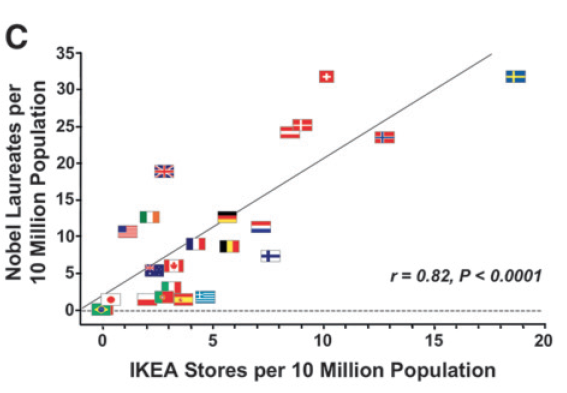
On the other hand, there is a very strong link between the number of Noble laureates and the number of IKEA stores in that country.

And that, surely, is proof why you need to throw out that old sofa and head down to IKEA. Today. You will think so much clearly.

Tuesday, June 18, 2013

Intermittent Fasting


When was the last time you were on a fast, eating a lot less than normal? The time you had the flu? That medical procedure that required a 12 hour fast, but delays extended it to 16 hours? Not much choice there, but have you ever deliberately chosen not to eat? Well, a few readers are hearing about the concept of occasional or intermittent fasting (IF) for good health and a long life. One big fan of the idea  is Michael Mosely (see pic), who has written a book on the concept of IF. It got a “leg up” on the back of his TV documentary on IF.
  
5:2 eating
The idea is simple. Eat normally, and healthily I presume, for five days and for two non-consecutive days eat only 500-600 Cals (2100 – 2500 kJs). Proponents excitedly explain that you will lose weight. No surprises there. Eat less food and we all lose weight. But is there more to this?

Early this year there appeared an interesting and balanced article in the Scientific American on IF. I recommend it to you as I won’t be repeating much of its information. It mentions Mark Mattson, Institute of Aging in the US, who has studied the area for many years and believes that IF is both brain and heart-protective. His work also suggests that periodic fasting might protect the neurons, lowering the risk of Parkinson’s Disease and dementia. He thinks that IF better mimics how we ate during most of evolution, and offers a survival advantage. If you could go a few days without food, yet still gather and hunt smart, you pass down clever genes. Most studies have been done on laboratory animals. Even if they are encouraging, they aren’t persuasive.

IF not protective against cancer
A recent  review of both regular fasting and IF in humans found no protection against breast cancer, but an increase in the risk of other cancers. Long-term Calorie restriction did see a non-statistical trend to cancer protection in mice, but nothing to get excited about. Their conclusion was to stick to what we have said for years: don’t get fat and eat well. You can’t sell a book with that kind of advice.

**No proof that IF better that good wholesome eating**
One thing I can’t do is separate the benefit of eating well and remaining a reasonable weight from the potential benefits of doing that AND following the 5:2 or IF routine. I know my own Basal Metabolic Rate is 1800 Cals (7500 kJs), done under proper laboratory conditions. I might need 3000 Cals (12500 kJs) or more on a very active day. If I eat less than a quarter of my needs on two days of the week, I just don’t think I can be active as well.

Here is the constant problem we face when trying to advise people of a so-called perfect health-enhancing diet – we live too long. That is, too long to make an assessment of any new diet theory, such as IF or the Paleo Diet. We would need many thousands of people following a new non-traditional diet idea for 60-100 years to then be able to say: “This diet, on average, will give you a lifespan of 120 years.”

The best we can do is observe those that have eaten a specific style for hundreds of years and lived to a good age, reasonably free of disease, and marry that with science of physiology and aging. The traditional Japanese and Mediterranean diets are the most realistic models we have at the moment.

What does it all mean?
Diet sensations come and go, get recycled, repackaged  and return because diet ideas are a commodity. Emphasise a need or concern, supply a solution and six months as a new diet book, with its accompanying cookbook. OK, so I’m not excited by IF, mainly because I haven’t enjoyed hunger nor do I think well when starving. I much prefer that we ate for nutrition, health, enjoyment, community and prepared food for pleasure and discovery.

So, if you like the idea, try it. I don’t think you will come to any harm. You probably won’t have the energy to exercise much on the semi-fasting days. As I have said before, you are your own boss. No evangelistic dogma from me. However, if you are an IF devotee, I would really love to hear of your experiences.

IF may be considered natural, but I think that eating when you are hungry, and drinking when you are thirsty, also neatly fit into a natural philosophy.