Sunday, July 14, 2013

Chocolate & Nobel Laureates


You all know that there is a big difference between an association, or correlation, and a case of cause and effect. The more televisions you own, the more likely you are to die early of heart disease. Could it be the light emission from the TV, or even something deadly from the weather report? Of course not. The more TVs you have, the more time you are likely to watch telly, the less likely you are to be out walking the dog, and you can complete the explanation yourself quite easily.

Last year there was a report in the New England Journalof Medicine demonstrating that there was a direct link between the national chocolate consumption and the number of Nobel laureates from that country. It was speculated that all those flavanols in the cocoa were a boost to thinking and chocolate consumption should be widely promoted for a higher national IQ.

The media, not being a discerning beast, didn’t read the article properly. If they had they would have twigged that it was written tongue in cheek. Instead, it was reported as a cause and effect and not just an association.


An article published last month in the Journal of Nutrition pointed out the folly of choosing a single correlation to make an assumption. Tea and wine also contain the antioxidant flavanols, yet there is no such association between consumption and brain power for these two popular beverages.

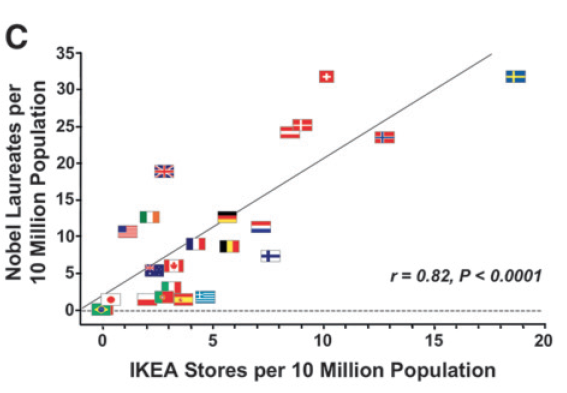
On the other hand, there is a very strong link between the number of Noble laureates and the number of IKEA stores in that country.

And that, surely, is proof why you need to throw out that old sofa and head down to IKEA. Today. You will think so much clearly.

Tuesday, June 18, 2013

Intermittent Fasting


When was the last time you were on a fast, eating a lot less than normal? The time you had the flu? That medical procedure that required a 12 hour fast, but delays extended it to 16 hours? Not much choice there, but have you ever deliberately chosen not to eat? Well, a few readers are hearing about the concept of occasional or intermittent fasting (IF) for good health and a long life. One big fan of the idea  is Michael Mosely (see pic), who has written a book on the concept of IF. It got a “leg up” on the back of his TV documentary on IF.
  
5:2 eating
The idea is simple. Eat normally, and healthily I presume, for five days and for two non-consecutive days eat only 500-600 Cals (2100 – 2500 kJs). Proponents excitedly explain that you will lose weight. No surprises there. Eat less food and we all lose weight. But is there more to this?

Early this year there appeared an interesting and balanced article in the Scientific American on IF. I recommend it to you as I won’t be repeating much of its information. It mentions Mark Mattson, Institute of Aging in the US, who has studied the area for many years and believes that IF is both brain and heart-protective. His work also suggests that periodic fasting might protect the neurons, lowering the risk of Parkinson’s Disease and dementia. He thinks that IF better mimics how we ate during most of evolution, and offers a survival advantage. If you could go a few days without food, yet still gather and hunt smart, you pass down clever genes. Most studies have been done on laboratory animals. Even if they are encouraging, they aren’t persuasive.

IF not protective against cancer
A recent  review of both regular fasting and IF in humans found no protection against breast cancer, but an increase in the risk of other cancers. Long-term Calorie restriction did see a non-statistical trend to cancer protection in mice, but nothing to get excited about. Their conclusion was to stick to what we have said for years: don’t get fat and eat well. You can’t sell a book with that kind of advice.

**No proof that IF better that good wholesome eating**
One thing I can’t do is separate the benefit of eating well and remaining a reasonable weight from the potential benefits of doing that AND following the 5:2 or IF routine. I know my own Basal Metabolic Rate is 1800 Cals (7500 kJs), done under proper laboratory conditions. I might need 3000 Cals (12500 kJs) or more on a very active day. If I eat less than a quarter of my needs on two days of the week, I just don’t think I can be active as well.

Here is the constant problem we face when trying to advise people of a so-called perfect health-enhancing diet – we live too long. That is, too long to make an assessment of any new diet theory, such as IF or the Paleo Diet. We would need many thousands of people following a new non-traditional diet idea for 60-100 years to then be able to say: “This diet, on average, will give you a lifespan of 120 years.”

The best we can do is observe those that have eaten a specific style for hundreds of years and lived to a good age, reasonably free of disease, and marry that with science of physiology and aging. The traditional Japanese and Mediterranean diets are the most realistic models we have at the moment.

What does it all mean?
Diet sensations come and go, get recycled, repackaged  and return because diet ideas are a commodity. Emphasise a need or concern, supply a solution and six months as a new diet book, with its accompanying cookbook. OK, so I’m not excited by IF, mainly because I haven’t enjoyed hunger nor do I think well when starving. I much prefer that we ate for nutrition, health, enjoyment, community and prepared food for pleasure and discovery.

So, if you like the idea, try it. I don’t think you will come to any harm. You probably won’t have the energy to exercise much on the semi-fasting days. As I have said before, you are your own boss. No evangelistic dogma from me. However, if you are an IF devotee, I would really love to hear of your experiences.

IF may be considered natural, but I think that eating when you are hungry, and drinking when you are thirsty, also neatly fit into a natural philosophy.

Paleofantasy


Last month I was given a book on the Paleolithic diet (PD) written by Marlene Zuk, a professor of evolution at the University of Minnesota. I discussed this topic late last year. Zuk covers it all in much more detail, explaining that there is no single PD, with the Australian Aboriginal diet differing to that of the native North Americans, the eastern Chinese and the early Mayans as they populated parts of South America.

Despite dairy and grain being banned on the PD there is good evidence that our genes have changed in the last 10,000 years (eg lactose tolerance in Indo-Europeans) and we have been eating grains for at least 30,000 years. Zuk cites evidence that even our gut bacteria have evolved over recent years to help us to digest new foods found as we spread over the planet.

There is discussion on other aspects of human evolution. Humans began life at sea level about 200,000 years ago. The Tibetan mountains have been populated for only 3000-6000 years and there are clear genetic differences in those that have adapted to the higher altitude. Tibetans breathe faster and have lower haemoglobin (yes, lower) levels for more efficient oxygen transfer. There are also recent genetic changes to resist malaria and be better able to digest starch.

This book is much more than a debunking of the idea that all was perfect in the Paleolithic era and that we have exactly the same genes as 10,000 – 20,000 years ago. It also discusses the evolution of sex and family. It is a very easy and enjoyable read. I have 12 “stickies” on the pages to denote passages I learned from; any book that has more than 5 stickies is a worthwhile purchase for me. As it is mainly text, I suggest getting the cheaper Kindle edition. Of course, you may prefer the smell of ink. Don’t blame you.

Another review, posted 11 June 2013, by colleague Bill Shrapnel is here.

Thursday, May 16, 2013

Diet-induced thermogenesis


Joel, a reader, wrote to me and asked which of the four macronutrients in food required the most kilojoules/Calories to be digested. The four macronutrients are protein, fat, carbohydrate and alcohol, the only ones that provide kilojoules/Calories in the diet.

His question related to the fact that we burn kJs to digest food, that is, you have to burn some kJs to actually digest and absorb the kJs used by your muscles, heart, brain, liver, kidneys, lungs etc. This is called diet-induced thermogenesis (DIT).

The textbooks will tell that an average 10% of ingested kJs form the DIT. For example, if you ate 10,000 kJs (2400 Cals) then about 1000 kJs will be used up to digest the food. So, which of the macronutrients “cost” the most kJs to digest and absorb?
  
And the winner is … 
It was the first time I had ever been asked that and I hadn’t clue, and that meant some detective work. You may have had your Basal Metabolic Rate (BMR) measured. After an overnight fast you lie very quietly in a room with no distractions, a pleasant temperature, breathing through a mouthpiece for 30 minutes. Clever people then determine how many kJs you need for your baseline metabolism to stay alive. The BMR is about 5% higher than your sleeping metabolic rate.

Now if you eat a meal and get re-measured under the same conditions you can work out from the difference how many kJs are needed to digest that meal. This time the test won’t be for 30 minutes because the process of completely digesting a meal and then absorbing the nutrients is likely to take 6 hours or so. Yes, you would have to pay me to do the experiment too. I mean, you can’t even watch telly during the test.

Although it would be nice to give you very precise numbers, nature is never that accommodating. Here is an approximation of the “cost” of digestion:

Fat: 0-3% 
Carbohydrate: 5-10% 
Protein: 20-30% 
Alcohol: 10-30%

Protein satisfies for longer
Mmm, so it doesn’t take much effort to digest fat. It is quite easy to break the bonds in a fat molecule and absorb the resultant fatty acids. Protein requires a bit of effort to break it apart with digestive enzymes before absorbing the amino acids. This may partly explain why high protein foods satisfy the appetite more than carbohydrate or fat.

Apart from digestion and absorption, where do the other calories go?
Just to complete the picture, aside from digestion, the rest of our kJs or Calories are burned to keep us alive (your BMR - heart beart, liver function, breathing etc.) and to keep us active (your daily activity: walking, running, popping off to the gym, cleaning your teeth etc). If there are any kJs left over, you know where they are stored.

Why do I keep mentioning both kJs and Calories (officially written with a capital C because it is an abbreviation of kilocalorie. Why don’t we therefore say Joules? Dunno, sorry). For those of you who went metric last century, or the one before, I remind myself that we have lots of good folk living between Mexico and Canada who still use Calories. Hate to leave them out of the conversation. Simply put, 4 kJs = 1 Cal. Close enough.

What does it all mean?
Not a great deal in reality. You don’t eat just a single macronutrient at a meal. It will be a mix of protein, fat, carbohydrate and alcohol if you have a glass of wine with the meal. Different combinations and different quality foods will take more or less time to digest.

You can bet that a meal of legumes, vegetables, mushrooms and nuts will take more kJs to digest than a donut, meat patty and a soft drink, even if they were matched for protein, fat and carbohydrate. I recently read that about 15% of the fat in nuts passes out the back end. That is fat neither digested nor burned, yet it is still “kJs in”.

The DIT is more an academic exercise than a guide to constructing your next meal. The figures are only approximations. Minimally processed foods are likely to require more energy to digest than a highly processed food. Anyway, thanks to Joel I’m a little wiser. Hopefully you are too. Eat well.

Selected references:
·      Westerterp KR. Diet induced thermogenesis. Nutrition & Metabolism 2004 
·      Shils ME et al. Modern Nutrition in Health & Disease 10th edition p 143 

Time between meals & snacks


Lindy wrote to me and asked what are the optimal times of the day to eat and the intervals between eating. Now, I could press the “nutrition guru, read my bestseller” button and make stuff up to sound knowledgeable. Or I could tell the truth. Let’s see how you go with the latter.

The best time to eat is when you are hungry. Yes, a crazy concept, and it won’t catch on, but it seems to make physiological sense. Then stop eating when you are no longer hungry. Whether that is a snack or a meal.

This is radically different to the “Ooh, looks nice, must try some”, “Hey, 1 o’clock, burger time”, “Man, I’m chockers, couldn’t fit in another morsel” way of dining while we live in a society with abundant food available 25/8.

I am being serious. Your body knows the best time to eat and drink. Nature comes with a clever operating system, complete with two inbuilt programs called hunger and thirst. Standard in all primates. Quite brilliant really.

Yes, it is more complicated than that. There are people who don’t experience fullness and always feel hunger. There are environmental cues that stimulate us to eat, whether we are hungry or not. The sight of Chocolate Bavarian seems to be able to over-ride all appetite cues. However, if you feel you have control of your eating most of the time, then eat when you experience hunger and stop when the feeling goes away. This is likely to be before you are full. We don’t have to complicate the message any further.